Osiris, Tammuz, Adonis, Attis and Inanna - the myth of the cycle of nature and the resurrection of Jesus
- Paulina Hańczewska
- 3 days ago
- 5 min read

There's a subtle but remarkably effective intellectual strategy: not to deny outright, but to blur. Not to refute, but to juxtapose. This creates the belief that Jesus' resurrection was nothing exceptional, because "gods who died and came to life were worshiped from ancient times." This thesis—repeated in popular literature—appears to be erudite, but in reality it relies on a confusion of categories, a simplification of sources, and an ignoring of basic historical criteria. When subjected to analysis, it falls apart almost immediately.
First, we need to restore the precision of language. In the religions of the ancient Near East, there are indeed stories about deities associated with death and "return." However, these are mythical narratives, rooted in observations of nature: the death and rebirth of plants, the cyclical nature of the seasons, the rhythm of life and death inherent in the cosmos. Osiris does not return to life in the human world—he becomes ruler of the land of the dead. Tammuz does not conquer death—his fate is repetitive and seasonal. Adonis and Attis function within the symbolism of fertility, not history. Inanna returns from the underworld, but her "liberation" comes at the cost of another life; thus, it is not a victory over death, but a momentary postponement of it. In each of these cases, we are dealing with an image of a cycle, not an event that breaks it.


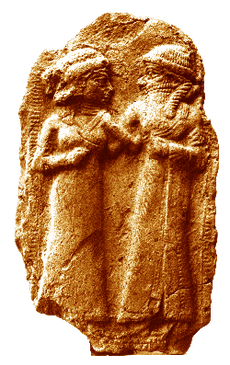
Depictions of mythological figures: Inanna and Dumuzi (Sumer), Osiris (Egypt), and Adonis and Attis (Greco-Roman world). Illustrations from Wikimedia Commons (Wikipedia). Authors: TangLung; Marie-Lan Nguyen; Sailko. Licenses: public domain; CC BY 3.0; CC BY-SA 3.0. Source: Wikimedia Commons (details available on file pages).
Meanwhile, the New Testament uses a term that defies this logic. The Greek word anastasis denotes a resurrection from the dead in a real, bodily, and irreversible sense. The Apostle Paul puts it unequivocally:
“Christ, having been raised from the dead, dies no more; death no longer has dominion over him” (Rom 6:9).
This sentence sets a boundary that no ancient myth crosses. In myths, return is part of a cycle; in the Gospels, it is its end. However, the most significant flaw in this popular thesis concerns not even the content of the myths, but the way the testimony is treated. A common accusation is, "It's all in the Bible." This argument is specious. The New Testament is not a unified narrative by a single author, but a collection of many texts created in different environments, at different times, and in different literary forms. Moreover, the oldest testimony to the resurrection—found in the First Letter to the Corinthians—precedes the redaction of the Gospel and contains an even earlier tradition that the author "received." We are therefore dealing not with a single narrative but with a multi-layered message that bears the hallmarks of an early and intense witness. Importantly, Christianity does not arise in a historical vacuum. The existence of Jesus and the first Christian communities is also confirmed by non-Christian sources—Roman and Jewish. They don't prove the resurrection, but they do confirm the context: the figure of Jesus, his death, and the fact that his followers very early on preached something that went beyond the mere memory of their teacher. History therefore asks not "whether texts exist," but "how to explain what they describe." This is where the most common alternative hypothesis emerges: the disciples may have lied. This is theoretically possible, but historically extremely improbable. Lying as an explanation requires motivation. Yet the disciples gained neither power, security, nor wealth. On the contrary, their witness led to persecution, marginalization, and in many cases, death. It is difficult to accept the notion that a group of people would consciously create a false history to incur the highest price without achieving any tangible benefit.
Equally important is the nature of the accounts themselves. The Gospel texts contain details that would be inconvenient from a propaganda perspective: the first witnesses to the empty tomb are women, whose testimony had no legal force in the culture of the time; the disciples are portrayed as frightened, doubtful, and unable to understand the events. The narrative builds not the image of heroes, but of lost people. In historiography, this is one of the criteria for credibility: the presence of elements unfavorable to the author suggests that they are not the product of propaganda, but a reflection of memory.
Even more telling is the sudden transformation of this community. The same people who had previously fled and hidden began publicly proclaiming the resurrection in the very place where Jesus was executed. This is not a slow evolution of beliefs, but a sudden shift in attitude. History demands an explanation for this turning point. It's not enough to say they "believed"—one must identify the reason that gave their conviction such strength that they were willing to die for it.
In this context, the following passage takes on particular significance: "then he appeared... to more than five hundred brothers at once, most of whom are still alive" (1 Cor 15:6).
This is a statement that transcends the language of myth. It speaks not of an unspecified time and place, but rather refers to living witnesses. It implies the possibility of verification. In the ancient world, where polemics were lively and direct, such a declaration would have been easily refuted if it had no connection to reality.
Equally important is the issue of the empty tomb. Significantly, opponents of Christianity did not claim that Jesus' body still rested there. The dispute concerned the interpretation of the fact of its emptiness ("the disciples stole the body"), not the fact itself. This means that the starting point was common; only the explanations differed.
Comparing these data—Jesus' death, the empty tomb, the testimonies of many, the transformation of the disciples, and the rapid development of the community—history poses a question that cannot be ignored: what hypothesis best explains all these phenomena? Theories of collective hallucination do not explain the empty tomb. Conspiracy theories do not explain the motivations and consequences. Legend theories encounter the problem of timing—the account appears too early to be fully mythologized. This leaves the possibility, presented by the sources themselves: that something occurred that transcended previous experience.
In this light, juxtaposing Jesus' resurrection with myths about dying deities proves to be a mistake not only theological but also methodological. Myths express the human intuition that life is stronger than death, but they do so in the language of cycles and symbols. The Gospel asserts that what was once intuition became an event—one-time, historical, irreversible. Therefore, its language is not the language of myth, but of testimony.
Ultimately, the dispute isn't confined to ancient texts. It concerns the question of whether death is part of nature's endless rhythm or a boundary that has been crossed. Myths teach acceptance of cycles. The Gospel proclaims their breaking. And precisely for this reason, it cannot be reduced to them—because it speaks not of what repeats itself, but of what happened once and for all.


Comments